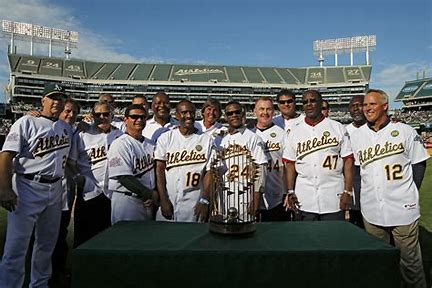
Man this is an interesting one to write. The Athletics, despite what modern perception may be, are one of the more prominent franchises in the history of Major League Baseball. They sit behind just the Yankees and Cardinals in terms of all-time world series championships, with nine, even winning four in their time in the Bay Area, including baseball’s last three-peat when they accomplished the feat from 1972-74. Yet, the A’s sit in a state of turmoil as the fanbase and city of Oakland continue to clash with ownership and the league regarding where the team will play in the future.
This makes things a little difficult to forecast what a potential championship team for the A’s would look like. They’ve refused to invest the level of money that has become the standard to compete at the highest level. While they certainly have shown a knack for making the most of their budget friendly strategy over the past couple of decades, they have failed to put together a team that has won it all since 1989. Keeping in mind the intention is for these rebuilds to be realistic, it’s hard to find what liberties can be taken without perpetuating a level of fantasy. The book and movie, Moneyball, certainly hold heavy influence on my views of team building throughout all sports, so I’m going to avoid ballooning the budget to a San Diego Padres level of spending. However, since owner John Fischer has said for years he is willing to invest more money into the roster once the team’s stadium issue is resolved, I’m going to assume that some sort of solution is agreed upon in the near future, and Fischer holds to his word by at least increasing the team’s player spending to some degree. I’m still going to narrow the primary focus of this three-part series onto acquiring and developing young talent. All this now said, let me lay the foundation.
Like I said in the opening paragraph, the A’s are not in a great place. Narrowing the focus to strictly on the field, this team projects as one of the worst teams in MLB. Depending on where you look, it is either them or the Washington Nationals with the worst odds to win the World Series. It’s no overstatement to say there are nothing but question marks on the roster. In the offseason the team continued what they started last year by trading away any player that had even average big league level talent. Most notable: catcher, Sean Murphy; and pitchers, Cole Irvin and AJ Puk. It’s almost miraculous that somehow after a season in which the team went 60-102 they may have gotten worse. The signings of veteran infielder Aledmys Diaz and Japanese pitcher Shintaro Fujinami could possibly provide the team undervalued production, but even that would be if each player hits their ceiling or beyond.
In a way, this is the environment the A’s have thrived in when looking at their recent history. Since the turn of the century they’ve been a haven for revitalizing careers and blossoming young talent. Stars from life-time like: Jason Giambi, Miguel Tejada, Tim Hudson, Eric Chavez, Nick Swisher, Dan Haren, Huston Street, Josh Donaldson, Yoenis Cespedes, Sonny Gray, Matt Chapman and Matt Olsen, amongst others, have all either gotten their start or hit their stride as major leaguer’s while in Oakland. Other veteran players such as: David Justice, Scott Hatteberg, Jermaine Dye, Frank Thomas, Shannon Stewart, Milton Bradley, Bartolo Colon, Grant Balfour, Coco Crisp and Jon Lester have donned the green and gold at various points in their careers. The A’s have found a perfect blend of getting veterans at the right time, and getting the best out of their young talent to create some very good teams. It would be beyond optimistic to say that this year’s group is going to be one of the teams that surprises, but it’s worth noting that a return to relevance may be closer than appears.
While mlb.com currently ranks the A’s farm system as the 22nd best in baseball, they do have some intriguing high upside prospects. For a full list of the team’s top-30 prospects, I’ve attached a link here. The players who have the most exciting potential in my mind are: Denzel Burke, Lawrence Butler, Tyler Soderstrom, Zack Gelof, Mason Miller, Colby Thomas, Luis Morales, Jacob Watters and Gunnar Hoglund. I’ll talk a little more about these guys in the next part as they each become more relevant in terms of making the big league roster.
Given the state of the current roster and farm-system it’s probably realistic to say a timeline to championship level is 6-8 years, when being realistic about the teams talent acquisition strategies. I have to say though, as much as I love making projections, the idea of looking that far ahead seems daunting. So instead I’m going to lay out a plan that includes a them being non-competitive for the next two seasons (2023 & 2024), making a jump to at least decent in 2025, being a playoff hopeful in 2026 and then finally a championship caliber team by 2027. This gives 2-3 years for continued minimal spending before a gradual increase over the next few seasons as a stadium solution would be much more likely.
That’s going to do it for the introduction to my Oakland Athletics rebuild. Make sure to check out parts 2&3, as well as the rest of the rebuilds.
 Unqualified GM
Leave a comment